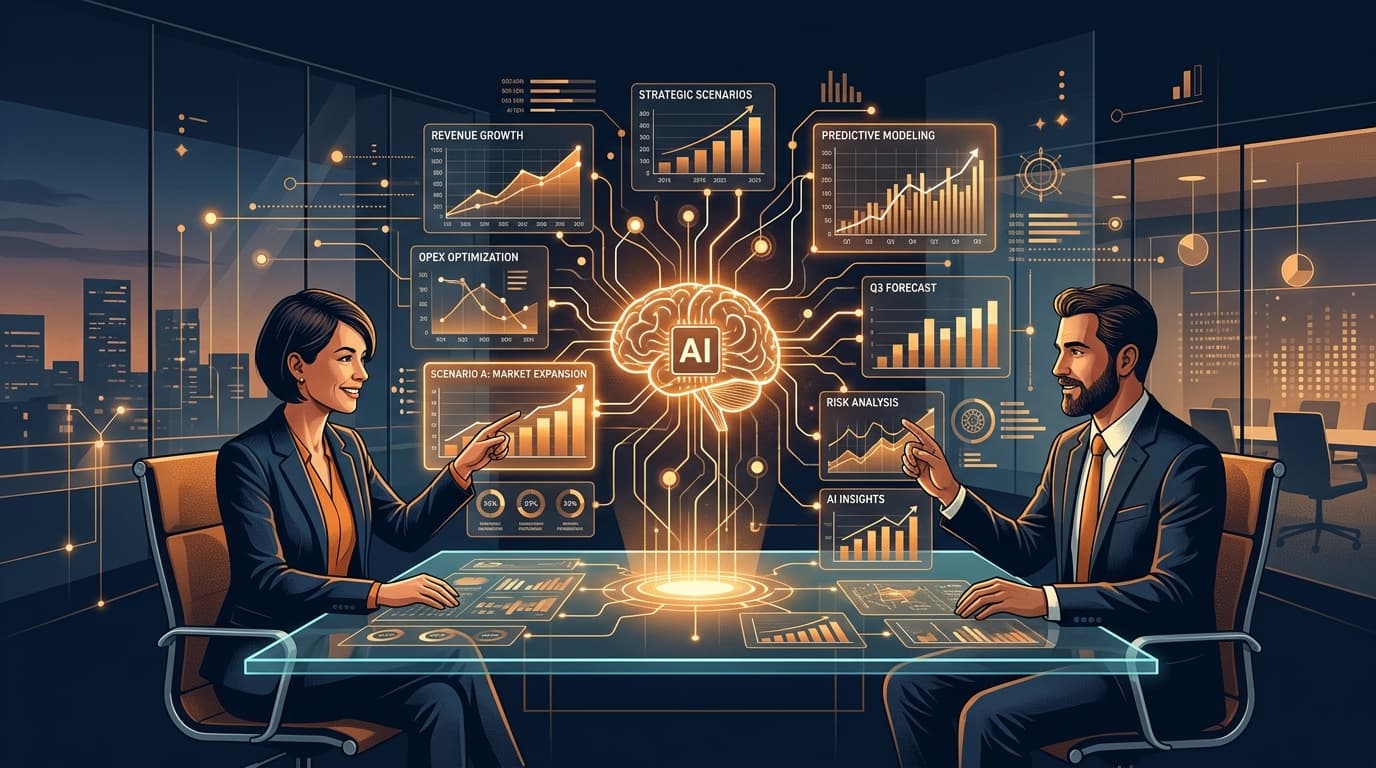
- 1Artificial Intelligence provides the computational engine, but Applied Intelligence produces real business outcomes through human context and judgment.
- 2Over 87% of finance leaders anticipate AI will fundamentally reconfigure finance workflows rather than simply cut headcount.
- 3In FP&A, AI shifts finance teams from spending 80% of time gathering data to 80% testing hypotheses and providing strategic advisory.
- 4Commoditized LLM access means tools alone offer no moat; organizational competitive advantage lies in prompt orchestration and execution.
- 5Effective governance requires setting firm guardrails around data privacy, model explainability, and algorithmic bias.
The Inflection Point: Moving from Defensive Stance to Strategic Orchestration
In business technology, conversations often follow a predictable evolutionary arc: first, we debate where to introduce a new capability, and only later do we figure out how to orchestrate it effectively. Marketing crossed this threshold earlier than most functions. Discussions among CMOs at major enterprise forums no longer center on whether to use AI, but rather on how to harness algorithmic speed while preserving human connection, brand voice, and emotional resonance.
Finance and Financial Planning & Analysis (FP&A), however, have been more cautious. Given strict regulatory mandates, fiduciary responsibilities, and zero tolerance for hallucinated figures, finance leaders have spent years debating where AI can be safely deployed. But that defensive posture is rapidly shifting.
Recent industry research underscores this inflection point. According to Deloitte's CFO Insights, over 87% of finance leaders anticipate that AI will fundamentally reconfigure finance workflows rather than simply cut headcount. Concurrently, Vena Solutions' FP&A Impact Report reveals that 70% of C-suites have active mandates for AI integration in finance, with over a third of core FP&A processes expected to be assisted by intelligent agents within two years.
The central question for CFOs is no longer 'Where do we test AI?' but 'How do we engineer Applied Intelligence?'
The Core Paradigm
Artificial Intelligence provides the computational engine, but Applied Intelligence is created when algorithmic velocity is paired with human context, qualitative judgment, and strategic orchestration. AI yields intelligence; human leadership delivers impact.
Defining the Shift: Artificial Intelligence vs. Applied Intelligence
To lead effectively in this environment, business leaders must distinguish between standalone Artificial Intelligence and Applied Intelligence:
| Dimension | Artificial Intelligence (The Engine) | Applied Intelligence (The Synergy) |
|---|---|---|
| Primary Function | High-volume computation, pattern detection, and automated variance flagging. | Contextual interpretation, strategic decision-making, and trade-off evaluation. |
| Core Orientation | Retrospective data crunching & statistical baseline generation. | Forward-looking scenario execution and value creation. |
| Focus Area | Data accuracy, speed, and process automation. | Business partnership, risk governance, and strategic alignment. |
| Human Role | Data compiler and manual validator. | Strategic navigator, prompt orchestrator, and ethical anchor. |
Applied Intelligence in Action: Three Key FP&A Use Cases
FP&A is an ideal environment for Applied Intelligence. Machines excel at managing scale and computational complexity; humans excel at navigating ambiguity, understanding organizational context, and establishing trust. Here is how that synergy plays out in practice:
- 1. Dynamic Rolling Forecasts & Contextual Variance Analysis: The Algorithmic Engine ingests historical ledgers, macroeconomic indices, supply chain lead times, and seasonal trend signals to flag anomalies. The Human Navigator injects unquantifiable context (enterprise contract negotiations, geopolitical shifts). Applied Impact: Shifts FP&A from 80% data gathering to 80% hypothesis testing and advisory.
- 2. Capital Allocation & Multi-Variable Scenario Modeling: The Algorithmic Engine executes thousands of Monte Carlo simulations in seconds across interest rate shifts, inflation, and FX volatility. The Human Navigator evaluates strategic trade-offs between defending margins vs. capturing market share. Applied Impact: Transforms capital budgeting into a dynamic, real-time strategic decision matrix.
- 3. Continuous Anomaly Auditing & Proactive Risk Governance: The Algorithmic Engine monitors transactions 24/7 across global ledgers to catch non-compliant expense claims and revenue recognition mismatches. The Human Navigator evaluates ethical nuances and updates governance frameworks. Applied Impact: Moves risk management from reactive quarterly auditing to real-time, preventative governance.
The Four Pillars of the Human + AI Equation in Finance
To successfully transition from viewing AI as a tool to embedding Applied Intelligence across the enterprise, finance leaders should focus on four operational pillars:
- Pillar 1: The Execution Edge — Beyond Tool Access. Commoditized access to large language models and analytical engines means software alone provides no moat. Differentiation lies in execution—how finance teams formulate business queries, interpret raw outputs, and translate insights into concrete commercial actions.
- Pillar 2: Contextual Anchoring — The Narrative Behind the Numbers. Algorithms extrapolate from past datasets, but business environments regularly experience unprecedented shifts. Human finance leaders provide narrative context, ensuring financial strategies account for culture, competitive dynamics, and brand equity.
- Pillar 3: The Functional Leader as Orchestrator. The modern CFO or Head of FP&A is no longer a chief accountant or data compiler. The role has evolved into that of an orchestrator, pacing machine analytics with human judgment to maintain operational agility.
- Pillar 4: The Guardrail Mandate — Governance and Trust. As AI agents assume greater analytical responsibility, human oversight shifts toward governance. Setting robust guardrails around data privacy, algorithmic bias, model explainability, and compliance is essential for preserving corporate integrity.
"Artificial Intelligence provides the capability; Applied Intelligence produces the outcome. AI is the engine, but human judgment remains the navigator."
Implementation Action Checklist
Conclusion: The Path Forward for Finance Leaders
The debate over whether AI will replace finance professionals is obsolete. The real competitive threat comes from finance teams that leverage Applied Intelligence replacing those that do not. By pairing AI's computational speed, pattern recognition, and scale with human intuition, ethical judgment, and strategic vision, financial leaders can elevate their organizations from reporting history to shaping the future.